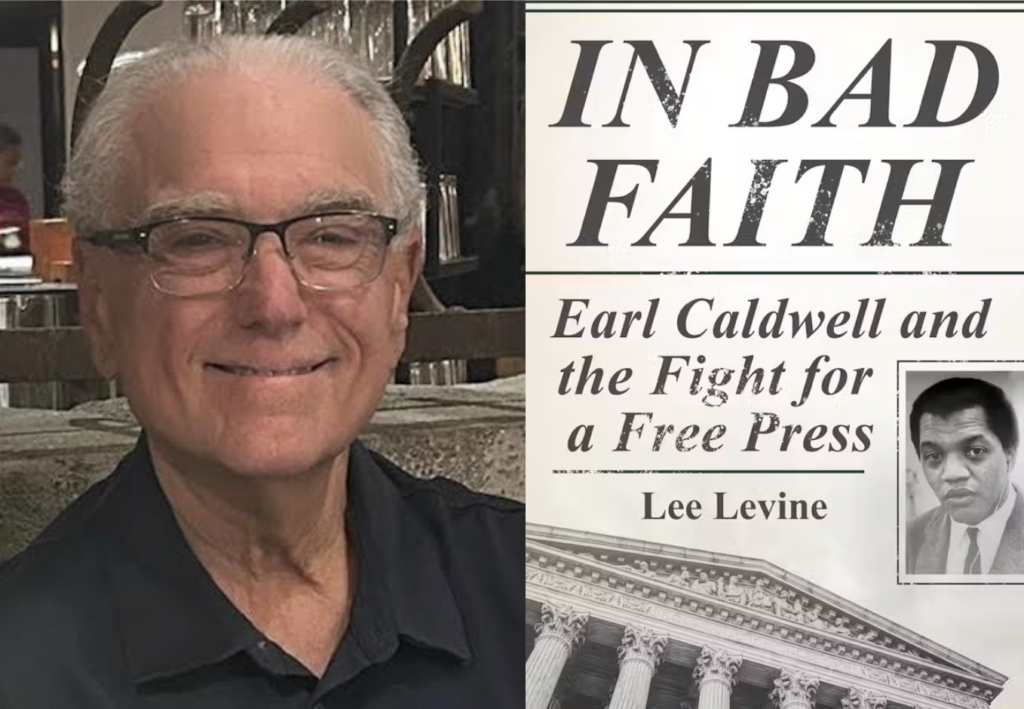
Lee Levine has practiced, taught, and written about First Amendment law for fifty years. He has argued on behalf of the press in courts nationwide, including the US Supreme Court. He taught at Georgetown University’s law school, has written three books, and regularly publishes in popular and academic journals.
On February 2, 1969, Earl Caldwell, then a National Correspondent for The New York Times working out of the newspaper’s San Francisco Bureau, was served by a U.S. Marshal with a subpoena commanding him to appear before a federal grand jury investigating the Black Panther Party. For much of the previous year, Caldwell had reported extensively about the Panthers, producing detailed accounts that were often at odds with the narrative favored by J. Edgar Hoover’s FBI and President Richard Nixon’s Justice Department—that the Panthers were a gang of violent thugs intent on murdering police officers and terrorizing White people. Convinced that complying with the subpoena would destroy the relationship of trust he had carefully built with Panther leaders and rank-and-file alike, Caldwell moved a federal district court to quash the subpoena, claiming that its demand that he betray his sources violated his First Amendment rights as a journalist. Persuaded by the arguments made on Caldwell’s behalf by his lawyer, famed constitutional scholar Anthony Amsterdam, federal judge Alfonso Zirpoli issued a protective order freeing Caldwell of any obligation to reveal information he received in confidence when he appeared before the grand jury. For The Times, its General Counsel James Goodale and its Managing Editor A.M. Rosenthal, Judge Zirpoli’s decision was a triumph—the first time a court in the United States had ever held that the First Amendment empowers journalists to keep their sources’ confidences from a prying government. For Caldwell, however, the matter was not that simple. He feared his very appearance behind the closed doors of the grand jury, regardless of what he did or not disclose once there, would make it impossible for him to continue to report about the Panthers. When Amsterdam advised Judge Zirpoli that Caldwell would not appear after all, the government moved to have him held in contempt of court and imprisoned until such time as he changed his mind. This excerpt from In Bad Faith begins with the hearing on the government’s contempt motion before Judge Zirpoli and proceeds to explore the fissures between Caldwell and The Times that it exposed.
“This is a fascinating and deeply revealing book about a single case from its commencement through its ultimate resolution in the Supreme Court. In Bad Faith is an intellectual treat for anyone, non-lawyers included, who are interested in journalism, race, the First Amendment and much more.” – Floyd Abrams, First Amendment expert, media attorney and author of “The Soul of the First Amendment”
 Lee Levine — “In Bad Faith: Earl Caldwell and the Fight for a Free Press”
From “In Bad Faith: Earl Caldwell and the Fight for a Free Press,” by Lee Levine, a Three Hills book published by Cornell University Press. Copyright © 2026 by Lee Levine. Used by permission of the publisher.
Adaptation of Chapter 7, “A Victory?” pages 149-156.
When the lawyers and Judge Zirpoli reconvened on June 5, Caldwell was in the courtroom. Under questioning by the judge, he reiterated his refusal to testify before the grand jury as well as “his constitutional objections to his compelled appearance.” Then, as Amsterdam described it, Caldwell “was duly held in civil contempt of court.” [Prosecutor Victor] Woerheide rose and asked Zirpoli to have Caldwell promptly taken into custody and incarcerated until such time as he agreed to comply with the court’s order. “The object of civil contempt is to force compliance,” Woerheide argued. “If he is at large pending appeal, that will vitiate the court’s finding of contempt.” Caldwell, as he put it years later, was “stunned.” As Amsterdam had hoped, however, Judge Zirpoli rejected Woerheide’s plea and “stayed his judgment of contempt pending disposition of the appeal.” That same day, Amsterdam filed a new notice of appeal.
By the time of the June 4 hearing, Jim Goodale had begun to hear reports from [National Editor] Gene Roberts that “Caldwell may be under terrific pressure not to go into the grand jury room.” Goodale also learned that Caldwell was then in New York and staying at the home of Gerald Fraser, whom Goodale described as “a fellow black reporter, who is known to be quite militant.” On Friday, May 15, the “pressure” on Caldwell began to be felt by the Times as well, when the NAACP Legal Defense Fund sponsored a “roundtable” in New York City about the “subpoena problem,” including most prominently, the one facing Earl Caldwell. It featured the likes of Mike Wallace, Cecil Poole, [the recently replaced United States Attorney in San Francisco who had refused the Justice Department’s and FBI’s request to empanel a grand jury to investigate the Panthers,] Ernest Dunbar, [a Black journalist at Look Magazine,] and Caldwell himself. Beyond Caldwell, the LDF invited no one from the Times, but Goodale sent his colleague Kathy Darrow to sit in the audience and take notes. What she reported back, and what Goodale dutifully communicated to Rosenthal and [senior Times executive Harding] Bancroft, was troubling.
As Darrow described it, at one point in the discussion, Fraser rose from his seat in the audience and asked Caldwell “whether he was alone in his fight against the Government subpoena.” When Caldwell responded that “he did not think he was alone,” Fraser disagreed. Caldwell, Fraser insisted, “was, indeed, alone.” Dunbar, who served as moderator, framed the issue as “of particular relevance” to the few “black reporters” employed by the mainstream media. To underscore Dunbar’s point, Caldwell emphasized that he had only been able to cover the Black Panthers because he had gained their trust, in significant part because he was Black. He would not, he continued, “be able to do the kind of things I have been doing” if he appeared before the grand jury. He provided a concrete example—his reporting on the Breakfast for Children program. The Panthers, he said, “gave me complete license to watch programs at work. No guide, no PR person to watch over me. Now,” he added, the party “probably wouldn’t give me the same freedom because I can’t say” that what I see and hear “is only for my newspaper.” From Caldwell’s perspective, the Justice Department and FBI were “trying to keep newsmen and sources apart.”
Poole told the audience that the “issue” is much “larger than Earl Caldwell’s case.” From his vantage point as a now former United States Attorney, Poole warned that the “Department of Justice,” which of course included the FBI, had become the “most powerful agency in the country.” It represented, he said, an “establishment” that had become “very frightened” by what it perceived as an “increase in radical activity in the country.” In response, the FBI had begun an “infiltration of radical organizations,” designed to keep it informed about their activities. The Bureau had requested that subpoenas be issued to journalists, he said, “not because they need the information but because they need usable evidence.” His “quarrel,” Poole said, was not with the “country’s right of self defense,” but with its claim of an “unlimited right of electronic surveillance” and the “threat to First Amendment rights” posed by its efforts to compel disclosure of reporters’ notes. The “real threat to justice today,” Poole concluded, “isn’t that radicals will be convicted but that in obtaining convictions we’ll lose our First Amendment rights.” He said he hoped the press would continue to be able to “keep America informed. It’s our property, not The New York Times’s, that’s involved.”
When Mike Wallace asked him what would happen if the government sought Caldwell’s testimony with respect only to “published material,” Poole responded, without hesitation, that he “would have to testify.” At that, Caldwell interjected that we would “go farther.” He did not, he said, believe there were “any reasonable limits” that could be placed on a reporter’s right to refuse to testify. “If you go to talk to a secret body,” he maintained, “they won’t trust you.”
A few days after the LDF forum, Goodale reached out to Caldwell and, as he described it in a file memorandum, “spent an hour on the telephone with him.” At the conclusion of their conversation, Goodale had come to believe that Caldwell’s position could not now “be as easily dismissed as being frivolous.” While Caldwell conceded that he was “willing and able to authenticate his story any time, anywhere, and any place at the time of Zirpoli’s decision,” Caldwell had not, Goodale now believed, anticipated the response that the prospect of his grand jury appearance, even for that limited purpose, would engender in the Black community. There had been heavy “pressure on him,” Goodale wrote in a file memorandum, “not to appear at all before the grand jury.” Caldwell, Goodale now recognized, had no choice but “to appeal Zirpoli’s order holding him in contempt in order to maintain his standing in the black community.” At that point, Goodale realized not only that “there was high sympathy for his personal decision” but that the Times should “give him the greatest support we could in” what he nevertheless continued to characterize as Caldwell’s “personal dilemma.”
Goodale’s change of heart, however, did not solve the Times’s immediate problem—the backlash to its failure to join in Caldwell’s appeal—both in its own newsroom and elsewhere. In late May, [Black journalist] Rush Greenlee published in Ball & Chain the transcript of an interview he and his colleague Gail Wells had conducted with Caldwell for KQED, a Bay Area public broadcast station. In the interview, Caldwell expanded at some length on the comments he had made at the LDF roundtable a few weeks earlier. The issue, as Caldwell saw it, was nothing less than “whether or not I’m going to be allowed to remain in this business as an individual.” If he were to appear before the grand jury, he reiterated, this time for a mass audience, it “would completely destroy my credibility as a newspaperman.” Caldwell put it bluntly: “I’m fighting for my right to stay in this business and be effective in it.”
That fact, Caldwell said, was at least in part a function of his race. If you are Black, he said, “and if you’re a reporter, when you’re dealing in the Black community to go with a press card is not enough. It doesn’t make any difference whether you’re representing The New York Times or a local paper, to be effective in the community you have to develop a special relationship, you have to develop a trust, because many people in the black community do look with suspicion on many of the newspaper and television stations,” including The New York Times. For him, as a Black man, “to go and participate in some secret proceeding where the community does not know what’s going on, they do not know what I’m saying—I think they would look on me in a very suspicious manner, and rightfully so. And so, yes, being black is a factor in what I’m doing.”
Greenlee then asked Caldwell to explain “the role of the Black journalist.” Caldwell presented his response in the form of a history lesson. “When I came to The New York Times a little over three years ago,” he explained, “there was one other black reporter on the staff. Now there’s more than a dozen. The prime reason for this is that there have been many things going on that the paper found it could not cover adequately with the staff that it had. So it was necessary to bring in black reporters to cover the black community and that required the black reporter to open up special relationships with the black people.” Because of that reality, he said, “I think the black reporter’s role” is to bring “some new understanding to the larger community and some proper analysis of the things that are happening in the [Black] community; to tell the larger community some of the things that are going on in the black community that it would not otherwise know.” In many ways, Caldwell had responded not just to the question Greenlee had posed to him, but to the anger directed at the mainstream media he had heard from Malcolm X years before in that church in Rochester.
Back in New York, Bancroft passed along to Goodale news that “there is some feeling on the third floor”—the location of the Times newsroom—“that we are not adequately standing behind Caldwell.” He suggested that they prepare “a short memorandum explaining why we were not a party to the appeal that Caldwell took last week.” Despite his well-meaning intention to assuage the newspaper’s staff, Bancroft’s suggestion set off a series of events that in fact served to escalate tensions, not only between the newsroom and the executive suite, but also between the newspaper and Caldwell. First, Goodale tried his hand at writing an article for Times Talk, an internal publication circulated to Times employees. In his handwritten first pass, Goodale emphasized that he “felt quite differently about this appeal than I did the earlier one. Here,” after all, “one of our reporters was faced with a jail sentence in effect for what he had written in The Times.” Although “Amsterdam was in effect making the appeal for Caldwell,” Goodale wrote, “the resources of the Pillsbury firm, the largest firm on the west coast, were being made available to Amsterdam to help in the appeal.” Beyond that, the Times would “write an amicus brief supporting Caldwell and indicate that he should not be required to authenticate his story unless the Government could show a need for the authentication.”
From those initial handwritten efforts, the project evolved from Bancroft’s suggested “short memorandum” to Goodale’s aborted piece for Times Talk to what became known as the “Rosenthal memorandum.” Initially drafted by Goodale, first in his own name and then in Bancroft’s, the memorandum was ultimately issued by the managing editor and posted in the newsroom on June16. From its earliest iterations to the final product, the memo sought to assure the newspaper’s staff that the Times supported Caldwell in his appeal, that it had paid and would continue to pay the Pillsbury lawyers to assist him, and that the Times itself would file a brief in the court of appeals on his behalf. That message, however, was largely lost, due to both unfortunate word choices and what by then had become a very skeptical audience. The final document began innocuously enough: “As you all know, the Caldwell case has reached a critical point. Earl Caldwell has been held in contempt, although his sentence has been stayed pending appeal. We all are concerned about him, and I thought I would bring you up to date on developments in his case so far.”
After that, the flash points began and quickly multiplied. For one thing, the memorandum stated that “The Times is providing counsel” for Caldwell through the Pillsbury firm—which was not technically accurate, since the firm was only representing the newspaper. Although the memorandum noted that the “NAACP Legal Defense Fund is also providing counsel” for Caldwell, it reinforced the impression that the newspaper was paying for that representation when it stated that all “other legal expenses will be paid by The Times, so that Mr. Caldwell will have no personal expenses in this lawsuit.”
Next, in attempting to explain why “The Times itself is not becoming a formal party to the appeal,” the Rosenthal memorandum described what it characterized as Caldwell’s refusal to appear before the grand jury to “authenticate his story”—that is, provide testimony “that his story accurately reflects what he had been told or seen.” This, the memorandum asserted, was all that Judge Zirpoli’s order had required Caldwell to do. Thus, while the Times management did “not disagree with Mr. Caldwell’s long-considered personal decision to fight against having to appear”—based on his belief that “just his appearance behind the closed doors of the grand jury would symbolize cooperation with the prosecution of the Black Panthers”—the newspaper was nevertheless obliged “to protect consistency and uphold the authenticity of The Times’s stories.” And, finally, in an effort to “make it quite clear that The Times has not dropped out of the Caldwell case,” the Rosenthal memorandum said the newspaper would continue “to assist Mr. Caldwell in the very difficult position in which he finds himself.”
From the moment he first read them, those last five words, no matter how well intentioned, fundamentally altered Earl Caldwell’s relationship with the Times. More than fifty years later, he could still recite them, and the date they were posted on the bulletin board, from memory. For Caldwell, the Times was refusing “to protect one of their own reporters,” as if what he had written in its pages “wasn’t even their reporting.” The Times, he believed, had both mischaracterized and dismissed the reason he could not appear at “a secret proceeding. I’m saying, if I go down there, the Panthers were like, ‘Whoa, whoa, what are you doing down there before a grand jury that’s investigating us if you aren’t going to tell anything about us?’ And that was right. So I said I’m not going.” And, beyond that, Caldwell could not understand where Rosenthal “came up with this issue of authentication being the issue. They didn’t know what . . . the prosecutor was gonna ask me. But that’s what they came up with. They put that memorandum on the bulletin board.”
Caldwell’s fellow Black reporters, both inside and beyond his own newsroom, read the Rosenthal memorandum the same way, and they were angry. Ernest Dunbar mobilized “Black Perspectives,” the New York–based group of Black journalists. He drafted and then issued on its behalf a detailed report titled “Neither ‘All the News’ Nor All the Truth: Earl Caldwell and the New York Times.” Dunbar began by explaining that, while the issues raised by the Caldwell subpoena “affect all newsmen,” the case “has a special and particular bearing on black journalists, who have access to the black community that white newsmen lack, and who, for the most part, return to that community when they leave the city room.” For that reason, he wrote, it is “of the utmost importance that the issues in Earl Caldwell’s case be clearly understood—especially by other Times journalists.”
Dunbar then proceeded to address the Rosenthal memorandum almost line by line, detailing what he described as its “misstatements, misleading assumptions, and what appears to be management’s effort to reassure Times staffers that they will be defended by the Times, even if Caldwell would not.” His effort began with the lowest hanging fruit—rebutting Rosenthal’s assertion that the Pillsbury firm was representing Caldwell and his suggestion that the Times was paying all of Caldwell’s legal expenses. “Fact,” Dunbar wrote. “Earl Caldwell’s attorneys are Anthony Amsterdam and Charles Ralston. They are being provided through the NAACP Legal Defense Fund. Pillsbury, Madison & Sutro are the New York Times’ attorneys.” “Fact,” he continued. Caldwell’s “attorneys have neither asked for nor received compensation from the New York Times. The administrative costs occasioned by numerous transcripts, filing fees, etc. in connection with the various court actions have, with the exception of the duplication of the initial papers . . . which was shared between the two sets of attorneys, all been borne by the Legal Defense Fund.”
Most significantly, Dunbar’s report took issue with the fundamental assumption that Rosenthal had said supported the Times’s refusal to join Caldwell’s appeal—that Judge Zirpoli had “granted an order protecting his [Caldwell’s] confidential information but requiring him to appear before a grand jury to authenticate his stories.” This, Dunbar asserted, was not true. “That may be the Times’ judgment about what will occur,” he wrote, “but it is their interpretation not a fact.” The court’s order, Dunbar emphasized, “is not limited to authenticating Caldwell’s stories.” The Times, he continued, had chosen to ignore “a basic contention on the part of its reporter, Earl Caldwell, and an issue that affects all Black reporters: Once he goes before the grand jury, which conducts its business in sessions closed to the public, the public will not know whether authenticating his stories was all he testified about or not.” Because of this, Caldwell’s “credibility, his promise to protect sources, his ability to function in the black community would be destroyed.” For the members of Black Perspectives, the Times’s reliance on “authentication” was a ruse. “Earl Caldwell,” Dunbar wrote, “has repeatedly stated that he would be willing to authenticate (i.e., testify that what he has written constitutes the truth as accurately as he could convey it) in an open courtroom or in some other public forum” and had “made that fact known to the Times’ management.” There was, he contended, “absolutely no valid excuse for this kind of misrepresentation, and all the rhetoric about the Times’ concern for maintaining ‘a consistent position on authentication’ is just that: rhetoric.”
News of Dunbar’s memorandum reached Goodale quickly. After he read it, he promptly prepared a rejoinder, which he shared with Harding Bancroft, Gene Roberts, and Abe Rosenthal. On the issue of who represented Caldwell and who was paying them, Goodale placed the blame for any misunderstanding on Caldwell. He wrote that Caldwell had, before he retained Amsterdam, “met with the Pillsbury firm,” at the Times’s expense, “and received preliminary advice on the subpoena.” Amsterdam’s retention, he continued, “placed The Times in the embarrassing position of deciding what do with” Jack Bates [the lawyer Goodale had initially retained to represent Caldwell], and his law firm. “This,” Goodale wrote, “was resolved by making the resources of the Pillsbury firm, the largest firm on the west coast, available to Amsterdam, who is essentially a solo practitioner.” To deal with the involvement of both lawyers, “Amsterdam appeared as of record for Caldwell and Pillsbury appeared as of record for The Times.” Substantially all of Pillsbury’s work, Goodale asserted, “had been done for the benefit of Caldwell.”
“Nonetheless,” Goodale continued, “after reading Dunbar’s memorandum, I called Amsterdam to ask whether the fees were a ‘bone of contention.’” According to Goodale’s account, Amsterdam responded “absolutely not,” adding that “Dunbar had asked him the same question and he had replied the Legal Defense Fund was paying costs as indeed it should since The Times had not made any appeals.” Goodale said he had assured Amsterdam that “if the expenses were causing ill will, we would be glad to pay them.” Ultimately, the Times did reimburse the LDF’s out-of-pocket expenses incurred on Caldwell’s behalf.
On the issue of the scope of Caldwell’s testimony before the grand jury, Goodale conceded “that if the Government can prove a compelling national interest and a need for Caldwell’s confidential information, then Caldwell will have to do more than authenticate his story.” Although Judge Zirpoli had “already noted” that the “Government has not proved such an interest,” Goodale wrote, “the real issue is that there is concern on Caldwell’s behalf that the Government can meet the test which has been proposed as providing the appropriate protection for a reporter.”
Goodale forwarded a copy of his memorandum (along with Dunbar’s) to Amsterdam, no doubt seeking his support in rebutting Dunbar’s indictment of the Times. Amsterdam politely demurred, writing that Goodale would “agree, I am sure, that it is most appropriate for me to refrain from comment on any of the points or answering points in the memos. I am,” Amsterdam wrote, “in contention with no one but the Government, and I want no part of any war between you and Ernest Dunbar, with both of whom I would like to remain on good terms.” He cautioned Goodale against providing his account to Caldwell, predicting that, in that event, “Earl may want to discuss it with me,” and he would likely “have to express some disagreements with portions of it.” Then Amsterdam gave Goodale a warning of sorts. “Insofar as” Goodale’s interpretation of Judge Zirpoli’s order “expresses a view that is contrary to one upon which I am basing my present advice to Earl, I may be forced to comment on it when Earl brings it to me and says: ‘I thought you said . . .’” He closed his letter by explaining to Goodale that while “I wish that I could avoid even this degree of comment—and will avoid it if I can—it may be inevitable. Be well.”
Tags