Legal Scholar Robert George on Institutional Neutrality, Campus Discourse and Fruitful Disagreement

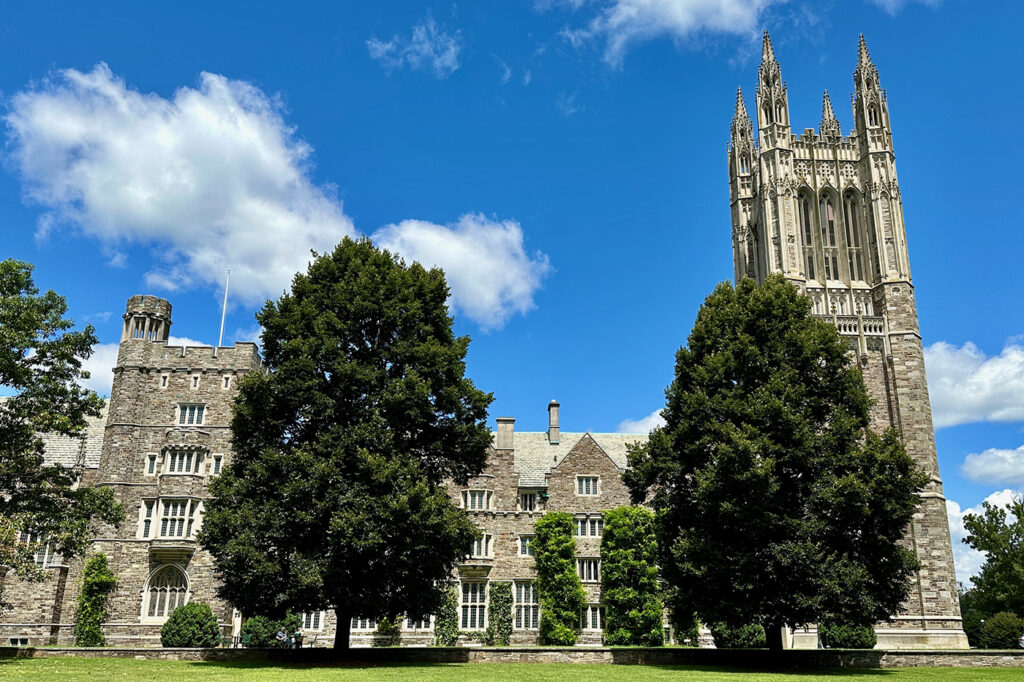
The Princeton University Graduate College in Princeton, New Jersey, July 30, 2023. Photo by Zeete via Wikimedia Commons, CC BY-SA 4.0.

By Sofia Cipriano

In April, James Percival, the general counsel of the U.S. Department of Homeland Security, was heckled at an event hosted by the conservative Federalist Society at the University of California, Los Angeles Law School. 

Over 150 demonstrators attempted to shut down Percival’s speech, chanting and carrying signs criticizing the Trump administration’s policy on immigration. Percival later complained of facing death threats on the campus. Several campus groups vocally opposed his presence.

The incident drew criticism from free speech defenders, some of whom argued that the students stepped beyond engaging in protected speech to shut down a speaker they disagreed with. 

The incident is the latest in a long string of speaker protests on college campuses. According to the nonpartisan Foundation for Individual Rights and Expression (FIRE), there have been 125 “deplatforming attempts” in 2026 so far — defined as instances on campuses in which individuals’ speech is actively disrupted, as opposed to being simply protested. In a time when political polarization and factionization is noticeably high, much attention has focused on whether campuses are open to diverse viewpoints.
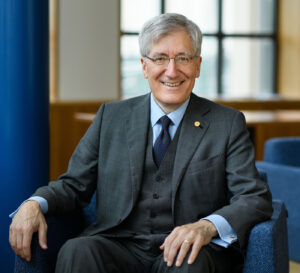
Photo courtesy of Robert George.

First Amendment Watch spoke with legal scholar and political philosopher Robert George about free speech in college classrooms and talking across differences. George has taught politics at Princeton University for more than four decades, and runs the bipartisan James Madison Program in American Ideals and Institutions, an academic institute that sponsors fellowships and speaking events. 

He has served as chairman of the United States Commission on International Religious Freedom and on the United States Commission on Civil Rights. He is a member of the Council of Foreign Relations and Academy of American Letters. His recent publications include “Truth Matters: A Dialogue on Fruitful Disagreement in an Age of Division,” co-written with liberal political thinker Cornel West, and “Seeking Truth and Speaking Truth: Law and Morality in Our Cultural Moment.” 

Editor’s Note: This interview has been edited and condensed for length and clarity. The interviewer, an intern at First Amendment Watch, has received partial funding from the James Madison Program in American Ideals and Institutions, of which George is director. The entire editorial process including choice of questions and editing of the conversation were run independently and solely by the staff of First Amendment Watch. 

FAW: I wanted to start by asking you a bit about institutional neutrality. How exactly do you define institutional neutrality? 

Robert George: Institutional neutrality is the position adopted by the University of Chicago in what is known as the Kalven Report. I think [it] is the correct position for non-sectarian or non-religiously affiliated universities. It’s obviously inappropriate and impossible for religiously affiliated universities. They have a distinctive element that’s introduced by their religious affiliation. What it stands for is that the institution, the official units of the university — not the private clubs, not the Democrat club, the Republican club, the Libertarian Club, the Socialist Club, the religious chaplaincies, and so forth — should take no position on issues of public policy on which members of the community can and do disagree, but should rather provide an impartial forum for the debate and discussion of those ideas without the university’s thumb on the table.

Now I need to enter two caveats. Universities may take positions even on public policy disputes where the dispute has to do with the mission of the university. So let’s say that a state legislature would enact legislation forbidding universities within their jurisdiction, private or public, from teaching divisive concepts — let’s say from discussing critical race theory, or anything like that — that kind of legislation directly affects the functioning and mission of the university, so Rutgers or Princeton, in my view, consistent with the Kalven principles, could and should oppose that legislation. 

Caveat number two: When we say institutional neutrality, it’s really important to understand what we are asking universities to be neutral on, and what we are not asking universities to be neutral on. We’re asking them to be neutral on questions like Israel and Palestine, whether we should increase or decrease foreign aid, abortion, or policies on marriage or gender issues. Those are issues of public policy on which reasonable members of our community disagree, and neither the university nor the department of politics, or the gender studies department, or the department of biology, or anthropology should have a position on that, which would, by virtue of its being an official position, mark some as orthodox and some as heretical. So the politics department shouldn’t say we’re on the side of Israel or we’re on the side of Palestine, because if you do that, then students who don’t share that view are treated as outsiders — they’re basically told, “you’re not welcome as a major in this department.” It should rather welcome students as majors, whether they are on the Israel side of the debate or the Palestine/Gaza side of the debate on an impartial basis and provide a forum for the responsible, robust, and civil debating of the issue. 

Here’s what the university shouldn’t be neutral on: Whether the university is committed to the pursuit of truth. When the pursuit of truth requires free speech and civil discourse, the university can be completely partisan on those issues. Now, we’ll allow people to challenge those commitments and say, “I don’t think there should be free speech. If you have a certain view that’s evil, you shouldn’t be allowed to state it.” But we’re not neutral on it. Our position should be, “We’re for free speech, because we need free speech to prosecute the mission of the university.” We should not be neutral on academic honesty and integrity. We have a position on that. You don’t steal other people’s work. But [the university] should be neutral on issues of public policy that are debated by reasonable members of the community.

FAW: Along those lines, under the definition of what you think institutional neutrality is, according to the Kalven principles, have universities moved away from this neutrality to express positions on major issues? How would you assess the current state of institutional neutrality, and how do you feel about it at Princeton, where you teach? 

George: It’s actually gone in the opposite direction. More universities have adopted institutional neutrality. Sometimes they haven’t used that label because they worry that if you just say institutional neutrality, it will suggest that we’re neutral on things we shouldn’t be neutral on, like academic honesty or freedom of speech, but lots of universities have endorsed the content of the Kalven principles, and many by the name “Institutional Neutrality.” Harvard has joined them, Vanderbilt University, Dartmouth College. So, I think that movement in recent years has been in the right direction. 

Now, let me add one additional caveat. None of this means that individual faculty and students cannot or should not take positions on issues. This is about institutional neutrality. You as a student, or I as a faculty member, or any of our fellow students and faculty members should be able to state their position on Gaza and Israel. In fact, the whole point of institutional neutrality is to provide that impartial forum, so that faculty members and students who have different perspectives on these issues can debate them to their own benefit and the benefit of the entire community. [I think that things] have been going slowly in the right direction. Not enough universities have adopted institutional neutrality. We at Princeton have not officially adopted the Kalven principles. I would favor our doing so. [Princeton] President [Chris] Eisgruber has endorsed what he calls “institutional restraint,” and my interpretation of what he means is that there’s a heavy presumption against the university or any of its units taking a position on a public policy issue, so it moves strongly in the direction of institutional neutrality, but still leaves at least some room — that I think should not be left — for the university and its official units to take positions on things. 

Now, in the past, some departments and programs have taken stances on public policy issues in a way that’s clearly out of line with the Kalven principles, with institutional neutrality, and I believe crosses the line even if we have the somewhat less stringent standard of institutional restraint. An example is after the Dobbs decision was handed down, reversing the Supreme Court’s decision in Roe v. Wade on the abortion question, the gender and sexuality studies program here at Princeton put out a statement condemning the Supreme Court, condemning the decision — that would clearly be out of line with Kalven report’s definition of institutional neutrality. It seemed to me that that even crossed the line if we have the somewhat less stringent standard of institutional restraint. I mention all this in an article in The Atlantic. I referenced that gender and sexuality studies statement at the beginning of the article, and I contrast that with a statement I could have made taking the opposite position in the name of the James Madison program, but I explained why I didn’t do that, because I think that would undermine institutional neutrality or institutional restraint. It would undermine or weaken the mission of the university and of my program by identifying it with a partisan ideology, and I want students, whether they’re pro-Dobbs or anti-Dobbs, pro-life or pro-choice, to feel welcome in the Madison program and feel as though they can debate those issues with their fellow students in a way that does not have any official thumb on the scale, and I think that’s how learning happens.
Students walk around the Princeton University campus in New Jersey, November 16, 2013. (Reuters/Eduardo Munoz)

FAW: I know you talked about how increasingly schools have adopted institutional neutrality, but in your recent book, you lament the rise of “campus illiberalism,” which, as you describe it, refers “to the unwillingness of so many members of college and university communities to entertain, or even listen to, arguments that challenge the opinions they happen to hold,” regardless of whether those views may be liberal or conservative. You say that “speaking invitations to dissenters from college orthodoxies are simply not issued,” or, if they are, they are pressured to withdraw. Are there ever moments when it may be justified to not want a particular speaker on a college campus — that is, are there any lines which speakers at universities ought not to cross? 

George: So, first, every university and every unit within a university has to make quality judgments on who to hire on the faculty, who to admit as students, who to invite as visiting speakers. I wouldn’t want the university to hire without respect to judgments of the quality of the thinking or arguments or work of people. That would be an abdication of the university’s responsibility, which, to my mind, is to confront our students and other members of our community with the best that has been thought and said by living and dead people across the political, ideological, philosophical, religious spectrum. I have no problem with making judgments of quality. What I would object to is where making judgments of quality becomes the pretext for excluding certain people on the basis of the content of their beliefs. If you take the view that conservatives never have good arguments and only progressive speakers attain the quality standards we need for our university, what’s doing the work there is ideology. I’m against ideologically litmus testing speakers. 

Relatedly, I believe that there’s a currency of academic discourse. Just as there’s an economic currency — it consists of pounds and pence in Britain and dollars and cents in the United States — there’s a currency of academic discourse, and that currency consists of reasons, arguments, and evidence. It doesn’t consist of name calling and so forth. So, if I’m thinking of whether I should vote for a candidate who’s being proposed for a professorship, or whether I should support a speaker coming in, one of the things I want to know is, does this person do business in the proper currency of intellectual discourse? I don’t want to hear speakers who call other people names, who shout, scream, who engage in defamation. They add nothing to the intellectual quality of our community. But if a person does business in the proper currency of intellectual discourse — gives reasons, makes arguments, provides evidence — then I’ll make my judgment on the basis of that and that alone, not what his position is, and whether I agree with it or disagree with it on the topic that the person is going to speak on. So if the person is somebody who is diametrically opposed to my views on religion, on philosophy, on ethics, on law, on politics, that shouldn’t count at all in the judgment about whether it’s appropriate to invite him to campus. All that should count is: does he make arguments? Does he provide evidence? Does he give reasons, not shouting, not name calling, not epithets? And is the quality of the work good? Does the quality of the work challenge me? Does it make me think, even though I disagree with it?

FAW: This is very much related — I was wondering if you had any particular commentary on the incidents at UCLA Law and Stanford Law. In both instances, speakers from the Federalist Society were protested by students, and controversial remarks were made by administrators. Is there any sort of difference between this happening at the undergraduate level versus at the law school level?

George: It’s bad wherever it happens. I don’t know the UCLA case that well, I just read about it. I do know the Stanford case [involving] Judge Kyle Duncan. That was a disgrace. I’d hate that kind of thing to happen at Princeton. It did happen with an Israeli politician at Princeton who was shouted down and couldn’t continue his remarks. That was disgraceful. In a way it’s even worse at a law school, because one of the things you’re being trained to do as a lawyer is to defend and apply the First Amendment with its protection of freedom of speech, freedom of religion, freedom of the press, now the freedom to advocate and defend ideas, and if you’re engaged in the shutting down of speech, it’s inconsistent with the law school’s mission. I think it’s inconsistent with the mission of any institution of learning, but there’s a special way in which it just strikes at the very heart of legal education. 

I don’t mind protest — protest is protected, and sacrosanct. Before somebody decides to protest a speaker, I think they should pause and ask themselves, “Would it be better, rather than protesting, for me to listen to the person? I could be wrong about things. If I seriously recognize my fallibility, I’ll realize I can be wrong, not only about the minor, relatively superficial things in life,  [but] I can be wrong about the big things — human rights, human dignity, justice. So, even if this person has views that offend me, maybe I can learn from him. I want to hear his argument.” I think, generally speaking, that’s much better than protesting.

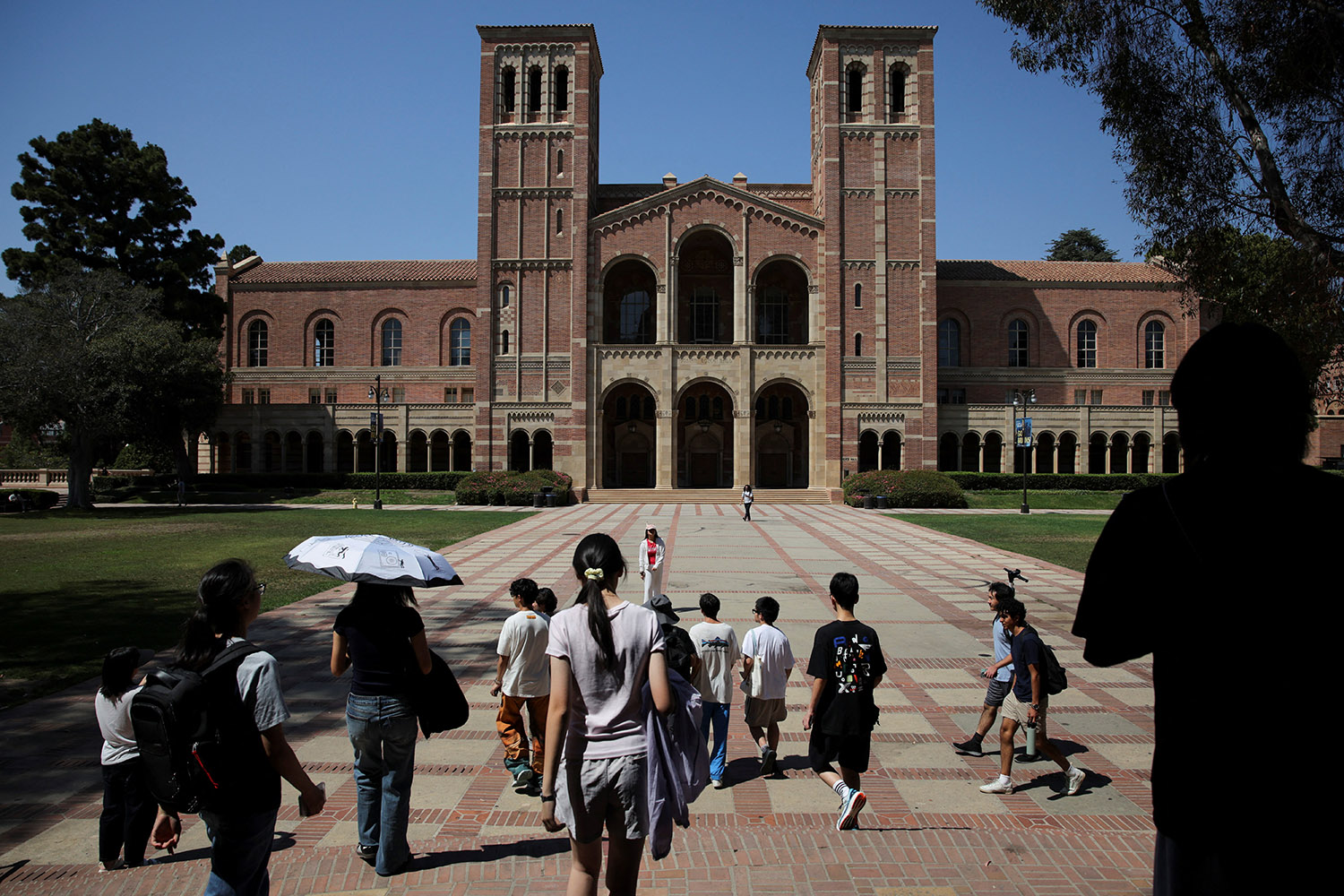
People walk through the campus of the University of California Los Angeles (UCLA) in Los Angeles

People walk through the campus of the University of California Los Angeles (UCLA) in Los Angeles, California, Aug. 11, 2025. (Reuters/Daniel Cole)

FAW: This is a broader question about campus liberalism — Do you think that this tendency goes back very far? What about the Vietnam War and civil rights era of the 60s and 70s?

George: Yeah, it does go back. There were even legal efforts to restrict some kinds of speech by faculty members or by visiting speakers on campuses in those days, most of the offenses against free speech came from the right. These days, they tend to come within universities from the left. Now, if they’re coming from outside the universities, often they’re coming from the right, like the Florida statute that bans the teaching of divisive concepts, but when the threats are coming from within the university, they’re generally coming from the left. So that’s been a change.

FAW: And this is a more of a practical question for today, but what specific steps can universities take, starting with freshman orientation, to improve respect for differing opinions and encourage respectful speaking across differences?

George: First, I think all universities should do what we at Princeton did, to our very great credit. In fact, we became the second institution to do it, and that is to adopt the University of Chicago free speech principles, which forbid the restriction of speech on the basis of content, with only the narrowest exceptions, those being the exceptions that are already in First Amendment law. We forbid threats, genuine threats of imminent violence, defamation, obscenity. University of Chicago enacted them in 2014, I believe we were the second institution in 2015. We were the first to adopt them by faculty vote. [At the] University of Chicago, the trustees adopted them. I’m very proud that we did it by faculty vote here at Princeton. And since then over 100 universities have adopted the University of Chicago free speech principles, so I would encourage all non-sectarian universities to adopt them, and even religiously affiliated universities, I think, should adopt something close to them, consistent with their own religious mission. 

Secondly, I’d like to see everybody adopt the Kalven Report institutional neutrality principles. I think that there should be a major component of all freshmen orientation programs that is devoted to teaching students about the mission of the university. The most fundamental mission of the university is not to get you to Goldman Sachs. That’s fine. We do want you to have great careers. We do hope our education here will help you to gain success in a profession, but that is not the most fundamental purpose of the university. The most fundamental purpose of the university is to form the young men and women entrusted to our charge to be determined truth seekers and courageous truth speakers. That’s it. That’s the fundamental mission. And to do that, you need freedom of speech. Our freedom of speech orientation program should be most fundamentally a mission of the university program, we teach them about free speech as part of teaching them about the mission of the university, which is truth seeking. Free speech is a condition of truth speaking. They should also be taught about intellectual humility, that’s a virtue that is a condition of truth seeking. If you already think you know everything and have nothing to learn, you have nothing to gain from a university education. The whole point of university education is to learn things you don’t know, to correct errors in your thinking. You need a recognition of your own fallibility that is not merely notional, in the sense that you would check the right box if you were asked, “Are you fallible or are you infallible?” But there’s a difference between the mere notional acknowledgement and the deep existential understanding that we really are fallible and fallible not only on the minor, trivial, superficial things, as I say, but even on the deep, important things, which means we have to recognize, we have to be humble, we have to develop and nurture the virtue of intellectual humility, so the freshman orientation program should stress free speech as a condition of truth seeking and intellectual humility as a virtue necessary for truth seeking.

FAW: Do you do anything in particular to encourage intellectual humility and also respectful disagreement in the classroom, and how do you handle self-censorship on the part of students who may disagree with the majority of people in the classroom?

George: [I put a statement on my syllabus for all my courses] about free speech and viewpoint diversity and the importance of making arguments. I encourage students to be devil’s advocates to advocate positions even if they don’t happen to hold them, just to see how far they can be defended. I put a lot of stress on the [need] to avoid self-censorship. Self-censorship undermines learning for everybody. If you fail to actually speak your mind, then you are denying your fellow students the benefit of your thinking in this collaborative community enterprise we call university education. So, I think students not only have a right, they have an obligation to avoid self-censorship and to speak their minds. Now, at the same time, I insist on certain standards of civility. Now, by civility, I do not mean mere politus, politeness, I mean engaging each other in the classroom and precepts, for example, in a truth-seeking spirit that is engaging each other in a spirit not only of “I’m going to teach the other guy something,” but “I’m going to learn something from him or her as well.” I think you have to create a classroom atmosphere if you’re a professor, together with your preceptors, in which students feel comfortable stating their positions, even if they know they are minority positions in this community or in this class. Professors, I think, should make a special effort to ensure that students feel comfortable speaking their minds as part of the larger, broader effort to fulfill your first responsibility as a professor, in my opinion, which is to confront your students with the best that has been thought and said by people who are living or dead across the ideological or philosophical or religious spectrum on whatever the subject matter of the course is, they need to hear the best arguments on the competing sides.

FAW: I wanted to ask about your friendship and scholarly partnership with Cornel West. I know you two recently co-published a book, and your friendship has been the subject of a lot of public interest. How may we see this relationship as a model for talking across differences, or as a good example of the sort of productive intellectual engagement you’ve been talking about? And what, if anything, have you learned about yourself or your beliefs through your conversations with West?

George: First let me say that my collaboration with my dear brother Cornel West has been the greatest blessing of my academic career. Not only have I enjoyed it, I benefited intellectually and in other ways immensely from the engagement. We were able to engage each other in a spirit of fellowship of brotherhood, despite our very significant difference on important questions, and that’s because both of us approach our vocations in a spirit of wanting to learn from our interlocutors, and with an acknowledgement that is not merely notional. We know we’re wrong about some things. We know we’re imperfect, we know we have some false ideas in our heads. [We can’t] attain [the] full truth perfectly. We both understand that, but we also both understand that if we’re to make any progress swapping out as many of those false beliefs as we can for true beliefs [as possible], then we’re going to have to open ourselves to challenge and criticism, and not treat somebody who challenges us as our enemy. What Cornel and I do, despite our differences, is we see each other— we do not try to win. We’re working together dialectically, giving the arguments back and forth to try to get at the truth. Both of us want the truth more than we want a victory in an argument. If I’m wrong, I do not want to win. I don’t want to be reinforced in a false belief of mine. The reason I’m wanting to argue with Cornel is, in case I’m wrong, I want him to persuade me, so that I can get off the wrong side and onto the right side. And Cornel has exactly the same attitude. 

Now, here’s the most important thing I learned about myself, and Cornell says that he’s learned the same thing about himself.  Although I have my views about things, and I will sometimes reveal [them] to students, I’ll always say, “Well, I think such and so, but you don’t have to think that, that’s a controversial position. I could be wrong about that.” I like to teach the arguments and positions that I disagree with in such a way that they’re in their best possible light that they’re in their strongest possible form, so that if somebody didn’t happen to know my position, they wouldn’t be able to guess my position from the way I presented a position I disagree with. I try my best to avoid giving a straw man version of, or a caricature version of, a position that I reject, because I think that’s important to the learning process. Students have to hear the best arguments on all sides, including sides I disagree with. What my work with Cornel, especially in the classroom, has shown me is I’m not nearly as good at it as I thought I was, and here’s why. Sometimes in our teaching together, he will make a point or develop an argument that simply never would have occurred to me for a certain position. He’s like me, he teaches in a way that doesn’t just give his point of view. He prides himself, just as I pride myself, on being able to make the best possible arguments for views he actually doesn’t agree with, but he says he learned from me in the same way that I learned from him by hearing me make arguments in response to points he had made that hadn’t occurred to him, so that’s the most important gift I think, that we’ve given to each other when it comes to pedagogy to teaching.

More on First Amendment Watch: