Attorney William Brewer on New York’s Even Year Election Law and the First Amendment

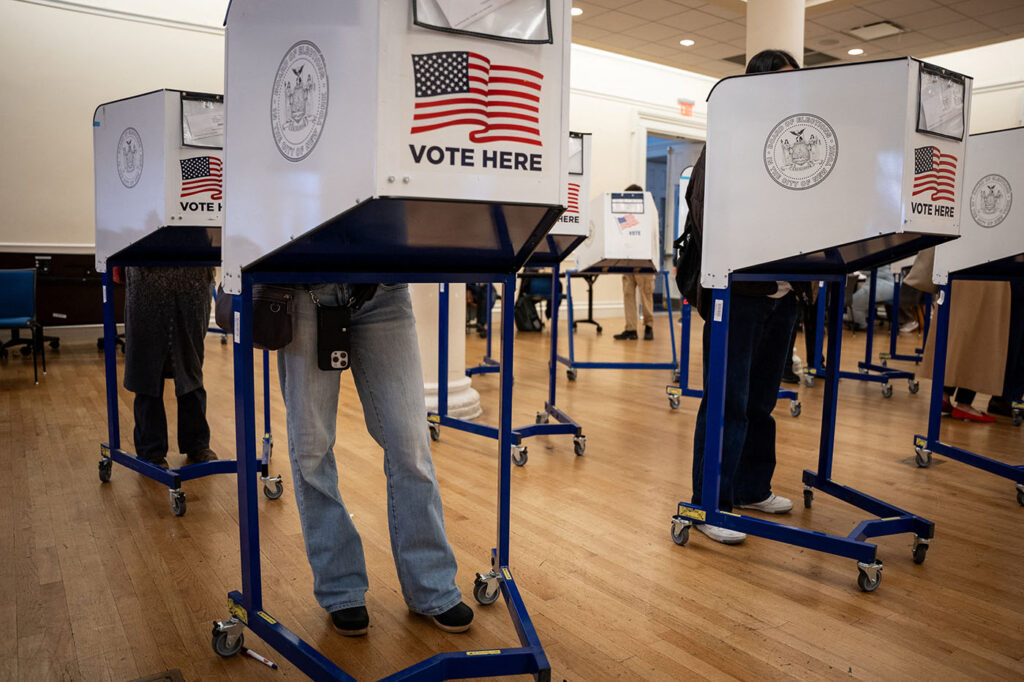
Election Day in New York City Brooklyn borough
Voters fill out their ballots at the Brooklyn borough hall polling site on Election Day in the New York City Mayoral Election in the Brooklyn borough of New York City, Nov. 4, 2025. (Reuters/Angelina Katsanis)

By 

New York’s GOP and various counties have challenged the constitutionality of the state’s Even Year Election Law (EYEL) in federal court, claiming the law violates the First Amendment and the Voting Rights Act of 1965.

The law, passed in 2023, moves local elections to even years to coincide with presidential and statewide elections. Proponents of the law argue that moving the elections to even years increases voter turnout, but opponents argue that the change deepens the state’s already Democratic majority and top-of-the-ticket candidates would overshadow those found lower on the ballot.

“The EYEL violates the First Amendment because it actually and intentionally imposes severe burdens on candidates’ core political speech,” the complaint, filed by Brewer, Attorneys & Counselors law firm on Dec. 29, argued. “By mandating the consolidation of local races onto ballots dominated by federal and state contests without the ability of political subdivisions to opt out, the EYEL deprives local candidates of a meaningful opportunity to convey their messages to voters by pushing their races to the bottom of what will become exceedingly long ballots.”

The amended complaint follows a previous lawsuit filed in state court that was rejected by the New York State Court of Appeals in October. That court held that “there is no express or implied [state] constitutional limitation on the Legislature’s authority to enact the Even Year Election Law.”

The lawsuit not only seeks a declaration from the court that the law is unconstitutional, but also requests an order barring EYEL enforcement and an option for localities to opt-in or out.

In the state’s motion to dismiss the amended complaint, New York Attorney General Letitia James argues the case lacks merit to succeed on both the First Amendment and Voting Rights Act claims.

“Candidate Plaintiffs allege they will be outspent by national campaigns and their voices will be crowded out,” the Jan. 12 motion stated. “But these concerns do not implicate the First Amendment, which does not guarantee a level playing field in the marketplace of ideas.”

Headshot of William A. Brewer III.

First Amendment Watch spoke with William A. Brewer III, the lead attorney on the case. Brewer has experience in First Amendment litigation and previously spoke to First Amendment Watch when he was the lead attorney for the National Rifle Association (NRA) in its lawsuit against ex-New York state Department of Financial Services Superintendent Maria Vullo in 2018. The NRA had claimed she violated the organization’s free speech rights by allegedly coercing and threatening banks and insurers to sever business relationships with the gun group after the school shooting in Parkland, Florida where 17 students and staff members were killed. In a unanimous decision in 2024, the Supreme Court reversed a lower-court decision tossing out the NRA’s lawsuit, noting that “the critical takeaway is that the First Amendment prohibits government officials from wielding their power selectively to punish or suppress speech.” 

In this interview, Brewer discussed the First Amendment arguments in the challenge to the EYEL, explained why he disagrees with the state, and argued that campaigns like that of New York City Mayor Zohran Mamdani are representative of the importance of odd-year elections.

Editor’s note: This interview has been edited and condensed for length and clarity. 

FAW: What is New York’s Even Year Election law? How does it change how New Yorkers vote in local elections?

Brewer: Most local elections occur on an “odd cycle,” meaning in November, in the state of New York, that they occur in odd years. The reason for that really goes back to the late 1890s when what was then the Progressive Party and a reform movement intended to break political corruption. Almost universally, the solution was seen as [a need] to separate out the important issues that are debated and ultimately decided in local elections into odd years so that they would have their own space in the town square to communicate with voters about those important issues, and then statewide and national elections would go into even years. It not only worked, it swept the nation. Virtually every state, until just recently, had separated most local elections — city, county, towns, school boards and the like — into odd year elections versus even years, which are dominated by, of course, presidential races, but other federal elections, as well as statewide elections. It was perfectly aimed to solve the problem that it was intending to solve. And you saw a replication of that just recently in New York City, where you had a very consequential candidate who became the candidate for the Democratic Party. [Mayor Zohran Mamdani is] credited largely with turning out more people for a local odd year election than had been turned out since John Lindsay, who was such a consequential candidate running as a Liberal Party candidate who turned out [nearly] two and a half million people for that election. And that was extraordinary, because back then you only had one day to vote. Now you have several. But the fact is, when the issues are significant, when the candidates are attractive, and the people who care about those issues are informed, they come to the ballot box. 

Everywhere outside of New York City, the Even Year Election Law requires now that all of those local elections move from odd years to even years, and they will now compete for messaging, space and for attention of voters to get the information that is so important to those voters. They’ll be competing in the 2028 presidential election cycle. Good luck, if you’re running for county executive in Onondaga County, getting the attention of your voters. And so that’s unfortunately not only what will be the effect of the Even Year Election Law, it’s actually the intent. All of a sudden, what was from coast-to-coast seen as the solution to the corruption that came when Albany ran New York, and all party politics were being decided at state and national level, is now back. You see this polarized environment where everybody’s trying to reinforce whatever assets they have here in New York, just like the Democrats trying to break through in counties where the Republicans have typically done a more effective job communicating with the local population about what solutions they propose, especially in counties like Nassau and Suffolk, but others too, that are Republican strongholds that are of significant size, power, wealth. 

Republicans are doing it in Indiana and are frustrated that they can’t get control, they can’t break through the Democratic success in Indianapolis. You’re seeing it in Kansas, where Republicans are trying to impose an Even Year Election Law because it’s a deep red state, but Democrats are successful, typically, in electing candidates who represent choices that better suit the needs of the people in Lawrence, Kansas or in Topeka. And so all of a sudden, what was great for well over 120 years — more in many places — is now being politicized, and people are changing the election system in order to find a way to break down the success that their opposition party has had in certain places. 

The Supreme Court just ruled a couple of weeks ago in Bost that candidates have standing, and the First Amendment is here to protect candidates from non-natural, non-necessary burdens that are being orchestrated in an effort to interrupt the free flow of information between the candidates and their constituents, and that’s exactly what’s going on here. 

Think of the anomaly of this. I’m a Democrat, but I represent the Republican Party in this instance, because it’s a First Amendment issue, and we are associated with First Amendment advocacy. The majority, the overwhelming majority of the people who are Democrats live in the five boroughs of New York, in the state of New York. The overwhelming majority of the people who voted for the EYEL to be imposed statewide are actually assembly persons and senators out of the five boroughs. Their constituents rejected an EYEL for the five boroughs in New York, and therefore will continue to have their elections on odd years. And lo and behold, one of the people who was sophisticated enough to understand the importance of that was the now mayor of New York, who came out against Proposition 6, the EYEL for the five boroughs. He wisely came out against it because he recognized that if he was trying to get elected in 2028, probably wouldn’t have a very good chance competing against the top of the ticket. And yet, this consequential politician, this effective campaigner, but who was not just an effective advocate for himself, more importantly was an effective advocate for the changes he wanted to make and the things he believes New York can be and should be. That’s what got him the election.
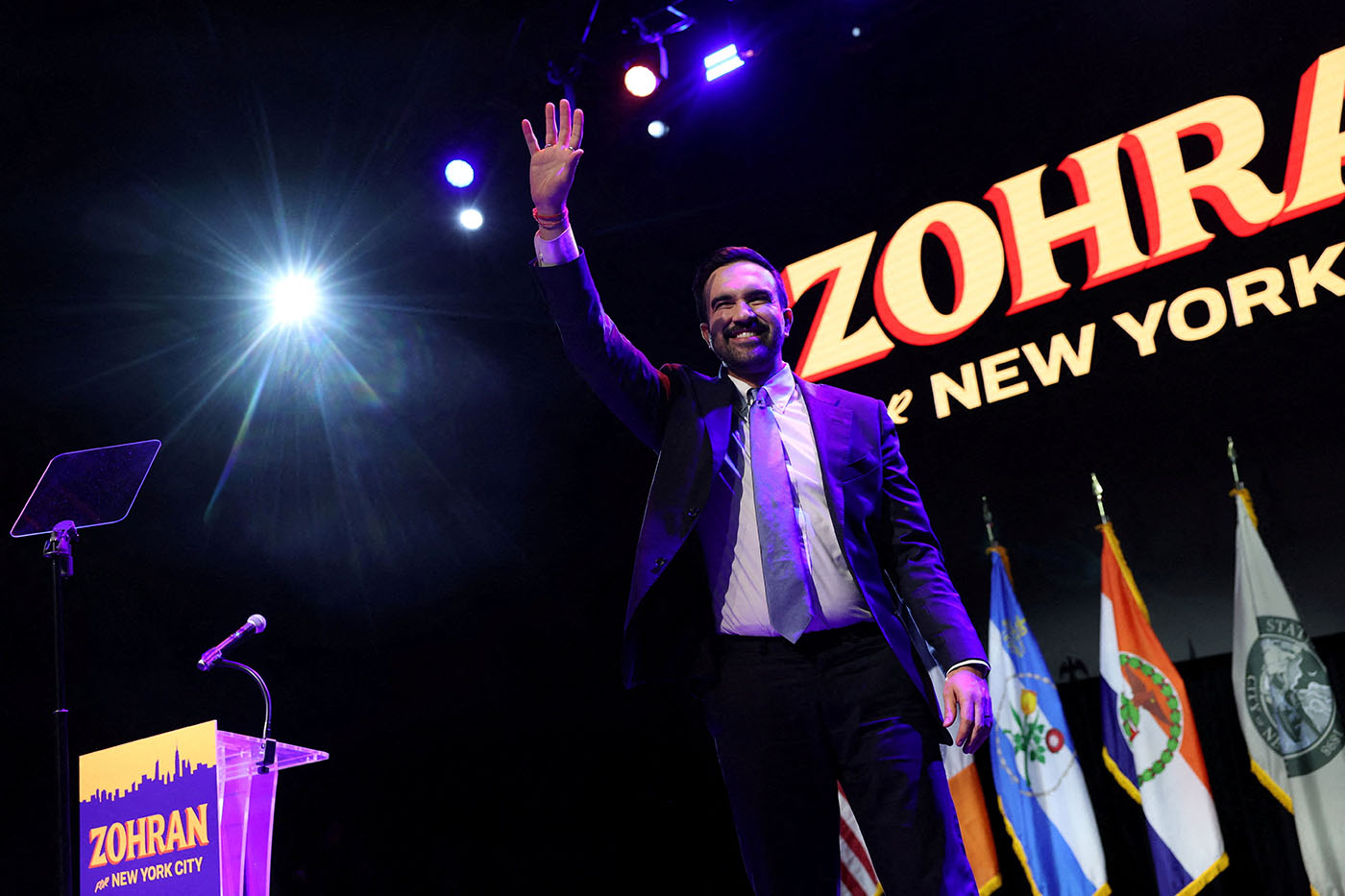
New York City Mayoral election

Democratic candidate for New York City mayor Zohran Mamdani waves on stage after winning the 2025 New York City Mayoral race, at an election night rally in the Brooklyn borough of New York City, New York, Nov. 4, 2025. (Reuters/Shannon Stapleton)

FAW: How specifically does the Even Year Election Law violate the First Amendment?

Brewer: By consolidating thousands of local races beneath high-salience state and federal contests, the Even Year Election Law purposely and effectively subordinates local elections to state and national political dynamics and diminishes the ability of local candidates to reach their constituents. By pushing local contests to the bottom of overcrowded ballots, the EYEL reduces visibility, drives up campaign costs, and weakens the connection between candidates and voters.

These burdens are widely recognized. Yet the majority party pursued these electoral changes knowing they would disadvantage minority-party candidates in local jurisdictions by drowning them out in higher-profile statewide and federal races. In fact, partisan actors are doing the same in other states when political roles are reversed.

The First Amendment protects not just technical ballot access, but meaningful political opportunity and robust debate. When the state deliberately redesigns election mechanics to bury a defined class of candidates and skew democratic competition, it imposes a severe burden on core political speech – and that violates the First Amendment.

FAW: What First Amendment precedents do you rely on? 

Brewer: We rely on the Anderson–Burdick framework established by the Supreme Court in Anderson v. Celebrezze and Burdick v. Takushi. Those cases require courts to weigh the real-world burden an election law places on political speech and association against the state’s asserted interests. The analysis is practical, not theoretical. 

As the Second Circuit explained in Yang v. Kosinski and the Third Circuit emphasized in Kim v. Hanlon, courts look at how a rule actually operates – not just whether a candidate’s name technically appears on the ballot. Structural burdens on political opportunity can be severe even if the law appears neutral on its face.

Here, the EYEL reshapes the competitive landscape in a way that predictably suppresses local political speech, and under Anderson–Burdick, that kind of burden warrants heightened constitutional scrutiny.

FAW: A previous challenge filed in state court was rejected by the New York Court of Appeals. Did the Supreme Court decision in Bost inspire you to file a separate challenge on First Amendment grounds in federal court? What First Amendment claims are you making?

Brewer: The case we brought began Oct. 30, 2025, and Bost is an important case that came out of the Supreme Court on Jan. 14. It was no surprise to us that just a couple weeks ago they were going to rule the way they did in Bost. Certainly, that’s what we predicted and hoped for. But they decided that candidates have standing. Candidates are putting themselves on the line spending time and effort to distinguish themselves, they need an opportunity to get into the town square, and that speech, that communication that they want to have with their potential constituents, should be protected from non-natural barriers. It is not a goal of the First Amendment to have more people who are uninformed about much of what they’re voting for, vote. That may be a political desire on the part of some, and certainly preventing people from voting is odious to the First Amendment. But importantly, the First Amendment is here to make sure that you as a candidate actually have an ability to reach your constituents, and a change in the system, in the law, that has the purpose or effect of preventing you from reaching your voters, that’s not a good idea. And really nobody who cares about local elections, and the politics that occur in the counties and the cities, would disagree with that.

Deep in our coalition are dozens and dozens of Democrats who believe what the Republican leadership believes, that this is bad law and that it will drown democracy out of the public debate. You will simply not get your message to most of your constituents and most of the people who are showing up at the ballot box in even years voting for county executive or town supervisor or comptroller, won’t have the foggiest notion who you are and what you stand for and what you’ll do differently. They will default to prejudice, which is what acting academics and data scientists tell us happens in elections when there’s too little information in the hands of voters. We just lived through it. Mamdani won and he didn’t have the most money, but his message resonated with the vast majority of New Yorkers.

FAW: The complaint alleges that the law “diminishes” a voter’s ability to associate. What does that mean?

Brewer: The business of communicating ideas is the business of associating. No surprise that free speech finds itself in the same amendment that protects your freedom to associate because your ability to speak openly, candidly and effectively — emphasis, underline, italicize the word effectively — communicate your ideas with others is part of building your association, building your cohort, if you will, to support change or to affect policy that is so critically important. Make no mistake about it, when we get into discovery in this case we will see. But we’ll see it in Indiana, where the Democrats are on the other side. They’re opposing an EYEL from Republicans. And anybody who is proposing one of these laws operates under the same thesis — doesn’t matter if you’re a Republican or Democrat — that these laws are designed to drown your messaging out of the ballot box.

There’s a case that recently came out of New Jersey, the Third Circuit [Kim v. Hanlon]. The court struck down a change in a voting system, because they were actually managing to move their opposition candidates to a different place on the ballot. And a data scientist came and said [a candidate’s position on the ballot matters]. We can measure that now. Thank goodness we’re in an age where we can enable courts to actually protect against laws that create unfair advantages, and the most extreme example of that are these EYELs. Before there was big data that could be easily aggregated and managed, everybody knew back in the late 1800s, “Come on. Knock it off, move the local into their own cycle in order to give them a fair chance.” Otherwise, you’re just literally making all politics, not local, but national.

FAW: In a statement to the Times Union, a spokesperson for Gov. Kathy Hochul said that the governor “believes our state is stronger when more people have the opportunity to participate in government.” Those who support the EYEL argue it increases voter turnout. Is that a bad thing?

Brewer: Unpack that. Start with the word “opportunity.” Nobody is being denied an opportunity to vote on Election Day in an odd year for candidates of their choice. The fact is they may not show up in as great a number because they don’t care as much. It is not a goal of the First Amendment to have more uninformed people voting for a particular candidate in a particular race. Everybody has the opportunity. It’s just a false premise. And if you talked to me on November 1, after I filed the case, that’s what I would have told you, but by Nov. 5, you would have agreed with me that that’s a silly argument that Hochul was promoting. And why would you have said “that’s silly” on Nov. 5? Because you would know that over 2 million people showed up at polls in New York City, and that’s the greatest number that had ever shown up at the polls to vote in local elections since 1969. But the reason it was so important is because the candidates and the issues were consequential. People knew where to go. They had the opportunity, and they knew how to exercise that opportunity, but they cared, so they showed up. And so what does it tell you? It tells you that everybody has the opportunity. That’s just a false narrative that they’re peddling. If you figure out how to reach your voters, the people who want to associate with you, get your message to them and help them get to the polls by motivating them to take the time to go vote. That’s it. If people don’t turn out in Plattsburgh, New York in November for the mayoral election, make it more consequential. Make it clear to people that this election matters to you, “You live here in Plattsburgh, and I will do the job you need done. I’ll make it better.” And if you do that, more people will turn out.

FAW: The complaint notes that the law does not apply to New York City elections, and that lawmakers in the five boroughs voted against a similar law taking effect in New York City. How does that work?

Brewer: This is a great anomaly. In New York, in order to apply the EYEL in the five boroughs of New York, there was an amendment to the charter of each of those boroughs that was required, and that amendment needed to be referred to the voters, not to their elected representatives. So the voters got to vote on what was Proposition 6. Every one of the other propositions passed, easily. Proposition 6 was rejected by almost 53% of the voters, so they went looking for it and voted against it. That’s an informed population that showed up to vote that day. That’s what we want. You want people who don’t just show up to vote for president or what they think is of consequence. No, you want people who are going to show up, who are informed and care to vote for their local candidates, the ones they support, and to make sure that that candidate they support has an opportunity to affect the policies that they believe will have consequences. That’s the anomaly. 

The lawmakers, members of the assembly, who come out of the five boroughs, lawmakers who are members of the Senate, who come out of the five boroughs, uniformly voted with the governor’s desire, and passed this EYEL that doesn’t even apply to the boroughs from whence they come, where their constituents live, and if they didn’t know that their constituents would not want this, they know it now. And why are they resisting making an amendment to this bad law that would enable political subdivisions, counties like Nassau or Orange County, or other counties, the opportunity to at least opt-out? Or if that’s what their voters want, let them have the same option that your constituents had. Let them decide if they would like to put it to their own voters, and if the voters don’t want it and would rather stay on odd years because they know that in their election their issues matter, and they want to have an informed electorate showing up, why not let them do that?

Editor’s note: This story has been updated to correct that the Brewer, Attorneys & Counselors law firm did not file the challenge that was rejected by the New York Court of Appeals.