By Stephen D. Solomon and Sofia Cipriano. Packaged by Susanna Granieri.
July 4, 2026 marks the 250th anniversary of the signing of the Declaration of Independence. But it’s not the only upcoming semiquincentennial milestone of great significance.
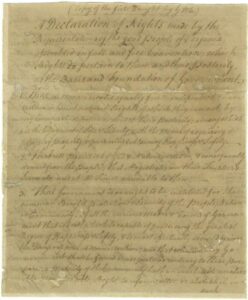
A copy of the first draft of the Virginia Declaration of Rights. Credit: Encyclopedia Virginia
On June 12, 1776, the Virginia Declaration of Rights established the first constitutional protection for freedom of the press in history — one that would be eventually enshrined in the U.S. Bill of Rights (1791). The Virginia Declaration, which inspired similar safeguards for the press in other state documents, proclaimed “that the freedom of the press is one of the great bulwarks of liberty, and can never be restrained but by despotic governments.”
Seditious libel law, which dated from a 1275 act of Parliament, applied to the American colonies as part of British common law, and some colonies enacted defamation limitations of their own. Those who criticized the king, Parliament or royal officials in America were often punished in the criminal courts. Prior to 1700, there were more than 1,200 documented cases of prosecutions for seditious libel in the colonies. That changed in the 1760s as the colonists started protesting the Stamp Act and other onerous British laws through newspapers, pamphlets, essays and public assemblies.
In the face of widespread protests, attempts to indict and convict Americans for their criticism of British authorities became increasingly difficult. Colonial juries effectively ignored seditious libel law; it was difficult to enforce in the colonies by 1776. That year, the Declaration of Independence cited the tyranny of King George III as justification for the colonies’ break from Britain. As the colonists cataloged the violations of their rights at British hands, they also sought to guard against future abuses. To that end, the new states began drafting their own constitutions and declarations of rights.
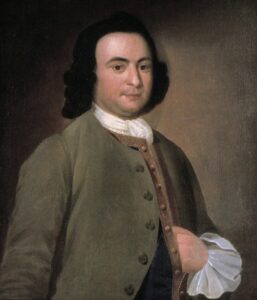
Portrait of George Mason painted by Dominic W Boudet in 1750. Credit: Wikimedia Commons.
The Virginia Declaration was largely drafted by George Mason, a Virginian farmer and founding father who was deeply influenced by the intellectual traditions that shaped the American colonists’ movement for independence. He drew on Enlightenment thinker John Locke, who advocated against censorship in his political writings and opposed England’s Licensing Act of 1695, and Montesquieu, who, in “Spirit of the Laws” (1748), argued that writings criticizing governments ought not to be criminalized.
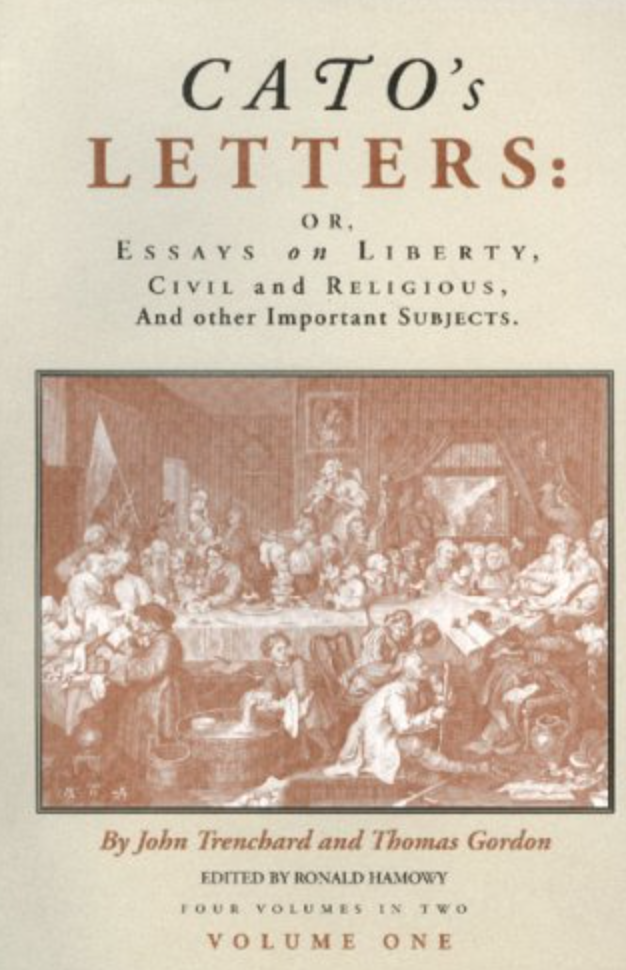
Perhaps Mason’s greatest influence was Cato’s Letters, a collection of essays written in the early 1720s by English journalists John Trenchard and Thomas Gordon — under the pseudonym “Cato” — and widely read throughout the colonies. The phrase “bulwark of liberty” comes directly from Cato’s “Letter 15,” which argued that free speech is necessary to preserve public liberty.
“Freedom of speech is the great bulwark of liberty; they prosper and die together,” the letter read, in part. “And it is the terror of traitors and oppressors, and a barrier against them.” With the right to criticize public officials, citizens can help keep power in check. Cato wrote of public officials that “to do publick mischief, without hearing of it, is only the prerogative and felicity of tyranny: A free people will be shewing that they are so, by their freedom of speech.”
Following the writing and dissemination of Virginia’s Declaration of Rights, other colonies followed suit, enshrining their rights in state declarations or constitutions. Pennsylvania’s Declaration of Rights, written in July 1776, declared, “that the people have a right to freedom of speech, and of writing, and publishing their sentiments; therefore the freedom of the press ought not to be restrained.” Delaware’s Declaration of Rights similarly asserted “that the liberty of the press ought to be inviolably preserved.”
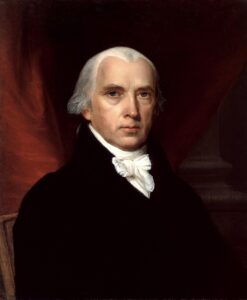
Portrait of James Madison by John Vanderlyn, 1816. Credit: Wikicommons.
Ten of the original 13 colonies ultimately included constitutional freedom of press guarantees. Freedom of speech was explicitly protected alongside press provisions in two states: Pennsylvania and Vermont.
James Madison, also present at the Virginian convention of 1776, would later use similar language in the Bill of Rights.
Mason refused to sign the Constitution in Philadelphia in large part because it did not include a bill of rights. At Virginia’s ratifying convention of the Constitution in June 1788, Mason and his allies proposed a list of amendments they wanted added to the Constitution. Many closely resembled protections in Virginia’s Declaration of Rights. The Constitution was ultimately ratified with the promise that amendments would be considered in the First Federal Congress.
The Bill of Rights, which was ratified in 1791, enshrined freedom of speech and press as a core American right. The First Amendment reads: “Congress shall make no law … abridging the freedom of speech, or of the press.”
In his report to the Virginia House of Delegates in 1800, Madison elucidated the meaning of the Amendment, underscoring the importance of freedom of speech and press. He wrote that sedition laws threaten the “right of freely examining public characters and measures, and of free communication among the people thereon, which has ever been justly deemed the only effectual guardian of every other right.” In other words, a free press is essential to a healthy democracy, allowing the people to check their representatives by holding them accountable.
In the decades since, the meaning of the First Amendment has been contested and litigated. The landmark case New York Times Co. v. Sullivan in 1964 would go on to establish the “actual malice” standard in libel cases, providing strong protections for journalists and others.
Justice William Brennan articulated the “central meaning of the First Amendment” as “a profound national commitment to the principle that debate on public issues should be uninhibited, robust, and wide-open, and that it may well include vehement, caustic, and sometimes unpleasantly sharp attacks on government and public officials.”
The meaning of freedom of the press — and the legacy of the Virginia Declaration of Rights — is still being debated today, 250 years later. But its importance remains central to a republican form of government, holding the powerful to account and protecting the marketplace of ideas.
Freedom of the press provisions, in order of writing: