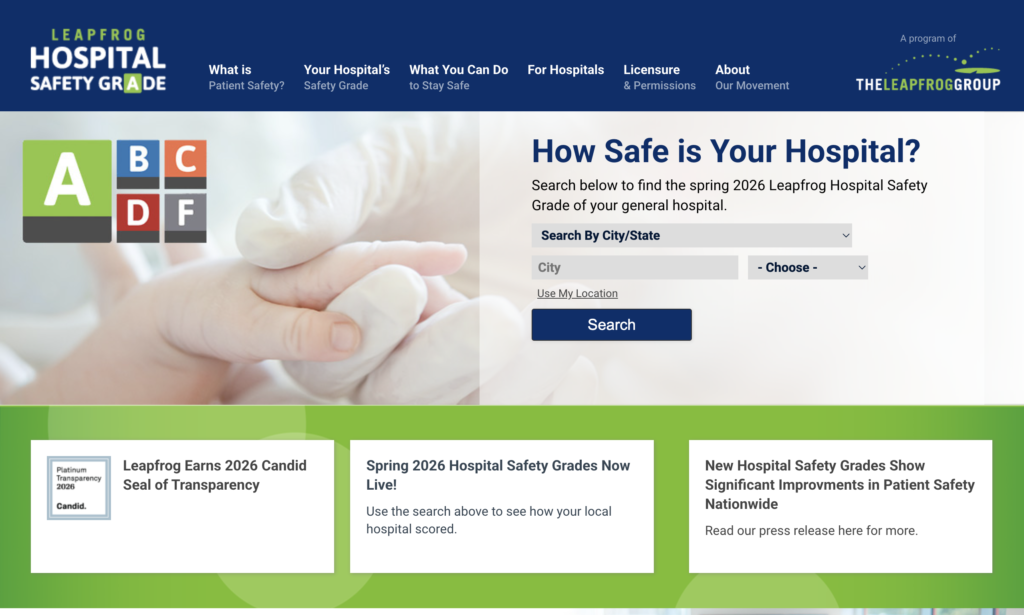
A nonprofit organization that surveys hospitals across the country and grades them based on standards of care, filed an opening brief in the U.S. Court of Appeals for the Eleventh Circuit after a lower court found its grading system violates Florida consumer protection law.
The Leapfrog Group — the organization that produces www.hospitalsafetygrade.org — was sued in August 2025 by five South Florida hospitals which were graded poorly for opting out of Leapfrog’s survey. The lawsuit described its grading system as a “brazen pay-to-play scheme.” The hospitals, owned by Tenet Healthcare Corp., claimed the organization’s methodology improperly rates hospitals that fail to provide information to the organization, effectively punishing non-participants. But Leapfrog argues it has a First Amendment right to review hospitals and objectively adjust its methodology as it sees fit.
“So long as the First Amendment still stands, this jarring assertion of judicial power to censor and muzzle the free press cannot,” Leapfrog wrote in its opening brief filed Sept. 10. “In the United States, the editorial judgments of a nonprofit watchdog about how best to inform consumers are not proper grist for scorched-earth litigation and judicial second-guessing.”
The core question of the case — which pits consumer protection law against the First Amendment — asks how the First Amendment protects ratings and reviews if claims arise that the methodology behind those reviews is unfair and misleading.
Leapfrog counsel Derek Shaffer, a partner at Quinn Emanuel Urquhart & Sullivan, said in an interview that there must be First Amendment consideration in the case, regardless of whether Leapfrog’s statements are subjected to the Florida Deceptive and Unfair Trade Practices Act.
“You still need to make sure that First Amendment protections are being honored while the statute is being applied,” he said, “and that didn’t happen in our case, which is what we find most concerning.”
In March, U.S. District Judge Donald M. Middlebrooks did not address the First Amendment arguments, and ruled that Leapfrog’s methodology “has no scientific basis, unfairly penalizes non-participating hospitals, and misrepresents hospital safety.”
Leapfrog has been assigning letter grades to hospitals since 2012 using publicly available information and surveys. The grades, ranging from A through F, focus on various hospital procedures and overall safety, including hand washing, types of surgical complications and even the teamwork of medical staff to “prevent errors.” But in 2024 Leapfrog updated its methodology to “impute,” or estimate, scores in certain criteria if the data from that hospital was missing. These estimates are often low, which brings down a respective hospital’s overall grade.
“Leapfrog does not have a right to the benefit of Plaintiffs’ participation; conversely, it does not have the right to punish them when they have not received that benefit,” Judge Middlebrooks wrote in his decision in the U.S. District Court for the Southern District of Florida. He ordered Leapfrog to remove the grades associated with the five hospitals, refrain from grading them in the future, and, along with disclosures, required it pay the hospitals’ attorneys fees, amounting to more than $10 million, more than Leapfrog’s annual budget, according to ProPublica’s Nonprofit Explorer.
Shaffer said this decision and attorneys fees award is a “huge threat to the organization” and “sends a very chilling signal to everyone else who might try to do anything akin to what Leapfrog is doing.”
That sentiment is shared by various news and free speech organizations, including The New York Times and Reporters Committee for Freedom of the Press, which filed an amicus brief Sept. 17 in support of Leapfrog, urging the Eleventh Circuit to reverse the district court’s decision.
The brief cited the 1974 Supreme Court decision in Miami Herald Publishing Co. v. Tornillo, in which the court “unanimously affirmed” the press’s editorial independence, a decision that has since been applied to other types of editorial publishing outside of traditional journalism. In Tornillo, the court cited a law’s failure to “clear the First Amendment’s barriers because of its intrusion into the function of editors in choosing what materials goes into a newspaper and in deciding on the size and content of the paper and the treatment of public issues and officials.”
“First, rankings, ratings, and reviews reflect the exercise of protected editorial judgment under the First Amendment and generally may not be actionable under a consumer protection regulation,” the brief argues. “Second, ratings and the underlying methodology constitute protected opinion, which cannot form the basis of a civil claim … Third, were an injunction with terms like the one in this case applied to fully protected speech, it would operate as a prior restraint and would compel a speaker to speak when it otherwise would not.”
A representative of the Palm Beach Health Network, which operates the five South Florida hospitals, argued in a statement to First Amendment Watch that the First Amendment does not protect Leapfrog’s “false factual statements or deceptive trade practices.”
“Tellingly, not even the organizations that have lined up to support Leapfrog on appeal are willing to defend the accuracy of its Safety Grade methodology,” the statement said. “Nothing in the District Court’s decision prevents Leapfrog — or any watchdog, journalist or consumer organization — from giving opinions about hospitals and engaging in protected speech. We look forward to the appeal and are confident that the District Court’s thorough decision will be upheld.”
Tags