The U.S. Court of Appeals for the Second Circuit on Aug. 17 became the ninth federal circuit court to affirm the First Amendment right to record police, extending the constitutional protection to more than 20 million people in Connecticut, New York and Vermont.
The case, Massimino v. Benoit, was filed in August 2021 by the American Civil Liberties Union (ACLU) of Connecticut on behalf of Wallingford, Connecticut resident Keith Massimino. The lawsuit argued that the detainment and arrest of Massimino by Waterbury police officers Matthew Benoit and Frank Laone violated Massimino’s First and Fourth Amendment rights.
In October 2018, Massimino recorded video footage of the Waterbury Police Department from the public sidewalk. Benoit and Laone asked Massimino to stop recording, and, according to the lawsuit, said it was a “security issue.” Laone reportedly detained Massimino, and when asked why, said it was because he was “filming a police station” and said Massimino committed the criminal offense of “reasonable suspicion.” Massimino was then charged with misdemeanor interference, and his recording equipment — including his camera, SD card, tripod, and cellphone — was confiscated. In May 2021, the charges against Massimino were dropped and the case was dismissed.
While the Second Circuit affirmed Massimino’s right to record police from the public sidewalk, it granted officers Benoit and Laone qualified immunity, which shields government actors from being sued unless their conduct violates a clearly established constitutional or statutory right that any reasonable person would have known. The court also ruled against Massimino’s Fourth Amendment claim, finding the officers “had reasonable suspicion” that led to his detainment and subsequent arrest.
“We recognize the difficult and dangerous job that law enforcement officers are called to perform on a daily basis,” the court’s ruling concluded. “In a democratic society, speech and scrutiny are not obstacles to performing that job. They are essential to it.”
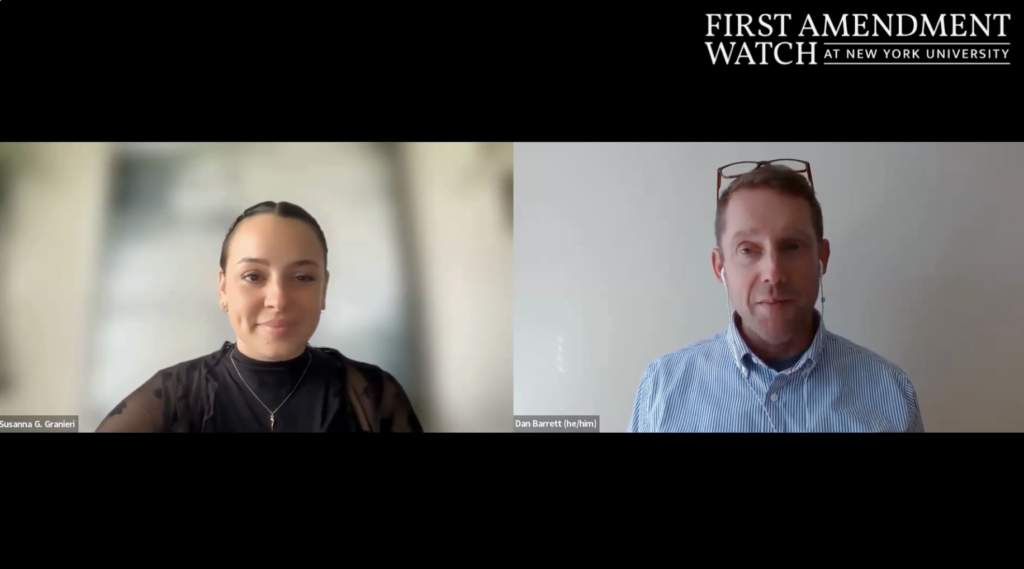
We spoke with Dan Barrett, legal director of the ACLU of Connecticut, about the case. Barrett celebrated the ruling, explained how filming is just a different way to newsgather and share information, and examined the tension between qualified immunity and officer accountability.
Watch the full interview below:
More on First Amendment Watch:
Teacher and Citizen Guides: Recording Video and Audio of Police Officers By 2019, more than 81% of Americans owned a smartphone, as compared to 35% in 2011. This has given rise to “citizen journalists” who record and disseminate videos of police officers performing their duties in public. Does the First Amendment protect them, or can the state prohibit the recording of police activity? First Amendment Watch, Free Speech Center Create ‘Recording Police’ In-Depth Video First Amendment Watch and the Free Speech Center at Middle Tennessee State University have partnered to create an in-depth video guide focused on the rights of those who wish to photograph or record video in public places like streets, sidewalks and parks. FIRE Attorney Zach Silver on the First Amendment Right to Record Police in Pennsylvania Silver outlined the First Amendment issues in the case and discussed why qualified immunity should not apply. Controversial “First Amendment Auditors” Test the Right to Film in Public Spaces Filmed interactions with police that make headlines or spread on social media is not a new phenomenon. But a growing movement of self-described "First Amendment Auditors" has forced some police departments to review how to respond to First Amendment audits.
TRANSCRIPT:
Editor’s note: This interview has been edited for length and clarity.
[INTRO] Susanna Granieri: Today I’m speaking with Dan Barrett, legal director of the ACLU of Connecticut, about the Aug. 17 decision in Massimino v. Benoit in which the Second Circuit joined eight other federal circuit courts in affirming the First Amendment right to record police.
Granieri: The Second Circuit joined eight other federal circuits in affirming the First Amendment right to record police. But what specific constitutional reasoning did the court rely on to solidify this First Amendment protection in this case?
Dan Barrett: I think there’s a couple of bases, but the one that stuck out to me was the lawful access to information. So in Houchins v. KQED, Inc. (1978), our circuit decided that this wasn’t a particularly difficult question. In part because there are decades of cases protecting our ability to access information that generates ideas and speech. Additionally, the circuit, like some of the other circuits, especially Glick [v. Cunniffe, 2011]. The First Circuit was kind of first out of the gate. Spent some time talking about how the right to record here serves a core democratic function of observing the government in action, and that hearkens back for First Amendment superfans to the access courtroom access cases and judicial documents cases, in which the principal virtue of those is that we get to see what the government is up to.
Granieri: And so I saw here too that the court had adopted the ACLU’s “plain-view parity” doctrine, and I was really interested in that. Could you tell me a little bit about what that means under the First Amendment and why the court held that police cannot ban recording of what’s already visible to the public?
Barrett: Yeah, “plain-view parity.” You may think of it as it’s either a restatement of a really obvious First Amendment principle, or it’s what I think we were trying to do was align us and the police on the streets and get rid of what in earlier cases had been an informational asymmetry. You will remember from crimpro [criminal procedure] that in the Fourth Amendment context, the police enjoy this thing called the “plain-view doctrine,” in which so long as they are lawfully present where they are making observation, they can generate probable cause from like bare eyeball observations. So if you go out and arguably commit a crime on the sidewalk, the police don’t need a warrant in order to conduct a search and generate probable cause. They’ve already generated it by what they can see with their eyes. For us at the ACLU, it seemed pretty obvious that the flip side of that was our First Amendment right to observe them when they’re in public. And although it of course doesn’t implicate the Fourth Amendment, the police have no privacy interests when they’re doing their jobs in public. On the other side of the equation, courts [and] police certainly were pushing the view that there’s something special about looking back at them, watching them do their jobs in public, and it seemed pretty absurd to think that we would land in a place in which the police could see us when we’re out in public, but we cannot record them. So that’s kind of the “plain-view parity” part of it. Now, if you’re solely a First Amendment nut, you can simply locate the result that we’re looking for and that we got in the whole line of cases discussing media, so from way back, from the ’30s. The U.S. Supreme Court has told us that the First Amendment remains constant even though the form of the media changes. And so the point that we were making to the circuit was, in a sense, a somewhat obvious one. Let’s say I am free to go out and observe a traffic stop from the sidewalk. If I am clear, as I think everyone would agree, to telephone a friend and describe to the friend using my words what’s happening there, then that line of cases about the form of the media not changing the First Amendment’s protections means that I could also, for example, draw a sketch of that, or I could record it with my phone because all I’m doing is transforming it into a different media. So we’re very glad that our circuit has agreed that that’s the case here.
Granieri: Yeah, absolutely. That answers one of my questions about comparing individuals recording to credentialed journalists, for example, and how those two acts of newsgathering, and just the sharing of information, are protected and hold the same status under the First Amendment. This recording was done outside of a police station, but given the court’s reasoning, what other buildings would presumably be treated in a similar way, or what might not? Can there be time, place, and manner restrictions placed on where these types of recordings are done?
Barrett: You probably saw from the decision that the court correctly noted that there were no freestanding or pre-existing restrictions at issue. This case solely concerned an on-the-spot, fabricated rule by the defendants that Mr. Massimino couldn’t record. The court couldn’t pass on the existence of a pre-existing rule because there was none, but noted that there may be an opening to create a time, place, or manner restriction on the recording of certain locations, correctly leaving it to whatever should happen next. It’s not clear to me that such a restriction is particularly viable. Although I think in today’s day and age, everyone’s probably thinking about schools. Nonetheless, any kind of time, place, and manner restriction is going to run into that same “plain-view” conundrum that the defendants here ran into, which is when the government exposes something knowingly, it is typically barred from imposing a speech restriction after the fact on the memorialization or retransmission of that information. And so you know you’re going to run into the point that we raised in this litigation, which is if the Waterbury police really wanted to obscure the exterior of their building, they were free to do that so long as the taxpayers would pay for it. They could build a fence, they could put in shrubbery, they could do all kinds of things. So I do think that any government building in the future that wants to claim or create a time, place, and manner rule is going to have to grapple with any efforts that the premises undertook, or not, to obscure the view from the sidewalk.
Granieri: I wanted to shift a little bit into qualified immunity. Despite the First Amendment precedent being set here and the right to record police in the Second Circuit, they did grant the officers qualified immunity. And how, if at all, does that immunity continue to shield officers from personal liability, even when a constitutional violation has occurred? And how does that impact their accountability more generally?
Barrett: Well, generally, I mean, I’m the last person to have spoken on this. I mean, there’s just been tomes written about it. It’s a tremendously pernicious concept that undermines our ability to enforce our foundational document, the national Constitution. And particularly to the extreme levels at which “prior occasion warning,” if you will — so the clear establishment of a right, has been insisted on by certain courts, particularly the U.S. Supreme Court — you find yourself in a society in which “cops have been reasonable” argument was ridiculous from a legal standpoint, but in our current climate, unless the exact same situation has occurred, they could not have possibly known that they were breaking something, or they were violating the law. Now, the knock-on effect is that in certain situations, it’s going to be virtually impossible to impose liability for violations of the Constitution, as here the court decided that, notwithstanding the fact that it wasn’t a hard question, for some reason these particular cops could not be asked to know or to predict the result. Even though at deposition they swore up and down that they knew that it was protected, it also jars with what we expect, particularly of police. We do expect them to know the law, and we expect them to make pretty basic inferential leaps about the law, even though it’s not entirely clear. But when it comes to qualified immunity, the federal courts are willing to say, “actually, inferences are too hard, and what we need is, you know, we’re only good for one-for-one pattern matching,” which is ludicrous. So in a case like this, where, as I said, there was no freestanding, there was no pre-existing restriction on Mr. Massimino recording the police station, no local ordinance, no state statute. The only way this case is litigated is via a damages action. That’s it, because this was a one-shot made-up by the defendants on the spot rule. This is the only, you know, damages is it. Now, in an ideal world, the city of Waterbury would take the result here and instruct its employees to knock it off. But in the real world, I don’t know what’s going to happen. The message could very well be “well because we weren’t liable, nobody really cares and let’s see what happens next time.” I don’t really know. I think many people other than me have thought and said a lot of things about police accountability but I can tell you as a litigator I usually ask witnesses, when I depose police witnesses, what notice that they get about developments of law, and also what happened in their cases when they had arrests turned over, when they had fruits of a search suppressed. Typically, the answer is nothing. They didn’t even know about it. So the fiction that the teaching of Massimino is going to trickle down in a real behavior corrective way, I’m not entirely sure. Although, of course, it is all we can do is create the law to ensure that if it happens again, anyone doing it is going to be liable and will have to pay it.
Granieri: Well, that was all of my questions for you. Is there anything about this case that I didn’t touch on that you think is important to pay attention to or to hear about?
Barrett: Well, other than now, the very busy triangle of New York, Connecticut, and Vermont now has a formal recognition that we are allowed to do something that has become very, very commonplace. I think it’s tremendously gratifying that the court reached its conclusion in a time in which recording the police and particularly ICE [U.S.Immigration and Customs Enforcement] has never been more important and is now beginning to be the “sine qua non” of democratic participation. We expect that our government’s behavior will be fully accessible to the public, and this ruling was just a tremendous step and a confirmation that that’s the state of affairs now. That we are able to see what they’re doing, who they’re taking away, who they’re arresting, and we’re just very happy for the result. Of course, we wish we could have gotten liability, but I know that Mr. Massimino is tremendously pleased that he’ll be able to audit in the future, and other people will be able to do things beyond auditing. They’ll be able to do citizen journalism and stuff like that. So it’s a good thing.
Granieri: Being a New York-based journalist, I’m sure that I’ll see this come up, and I can point to this precedent. But Dan, thank you so much for chatting with me about this case, and we’ll talk soon.
Barrett: Thanks very much for your interest. Talk to you soon.
Granieri: Okay, bye bye.